
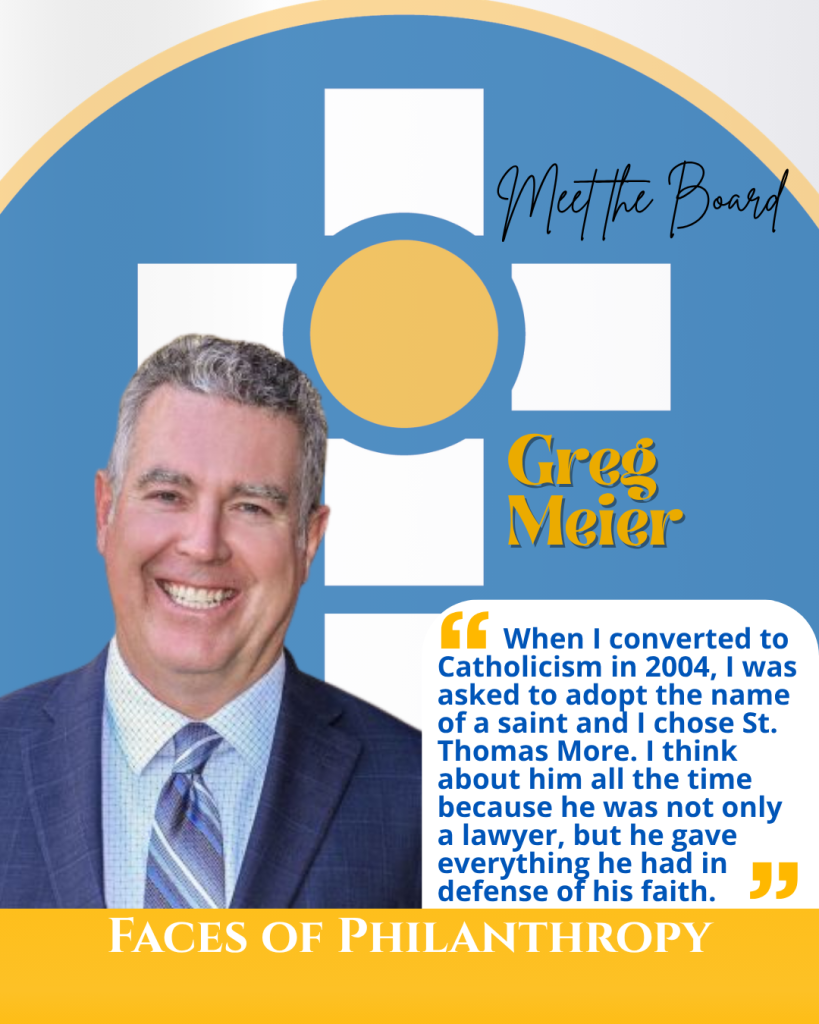
Greg Meier, JD, LL.M., CAP®
Board Member
Faces of Philanthropy: Greg Meier, JD, LL.M., CAP®
Greg Meier, JD, LL.M., CAP®
St. Margaret Mary
CFOCF Board Member
PGAC Member
DAF Fundholder
St. Katharine Drexel Society Member
Greg is an award-winning, Martindale-Hubbell AV-rated attorney in estate planning, corporate law, partnerships, federal taxation, and probate, representing individuals and families with complex business and estate planning needs. He handles corporate transactions from the creation of a business to succession planning. In addition, he practices estate planning law, including high-net-worth estate tax planning, wills, and probate. Greg believes, “In the practice of law, estate planning is one of the most important and personal areas in which you can work.”
Greg is admitted to The Florida Bar, The Georgia Bar, and is also admitted to practice in federal court before the U.S. District Court for the Middle District of Florida, and the U.S. Tax Court. He earned his J.D. degree, cum laude, from Stetson University, and his LL.M. in Taxation from the University of Florida. He holds a B.S. degree, cum laude, from Florida State University.
He is a member of The Catholic Foundation’s Planned Giving Advisory Council (PGAC) and earned his Chartered Advisor in Philanthropy (CAP®) designation as a member of the Foundation’s CAP® Inaugural Study Group. He lives in Winter Park with his wife Lisa, who is a founding member of the Women’s Philanthropic Giving Circle. Together they have a donor advised fund with The Catholic Foundation through which they support a variety of charities including their parish, St. Margaret Mary, and its Haiti Mission.
Faces of Philanthropy Q & A with Greg Meier:
Q: Is there a Scripture verse or saint that inspires your generosity?
A: When I converted to Catholicism in 2004, I was asked to adopt the name of a saint and I chose St. Thomas More. I think about him all the time because he was not only a lawyer, but he gave everything he had in defense of his faith. As for scripture, I’m inspired by Matthew 6:19-21: Do not store up for yourselves treasures on earth…but store up for yourselves treasures in heaven… For where your treasure is, there your heart will be also.”
Q: Is there a Foundation program or initiative that’s especially meaningful to you?
A: I’m a true believer and supporter of Catholic Education. Unfortunately, neither Lisa nor I received this blessing growing up, but we were blessed to be able to send all three of our children to Catholic School and we could not be more pleased with the education they received, but also more importantly, with how it helped shape our children’s faith and how they carry themselves in the world.
Q: What inspired you to create a DAF with the Catholic Foundation?
A: As a tax & estate planning attorney, it’s a natural tool for me to want to implement because of all the inherent advantages it offers. I actually wish we had started one earlier! It really allows for a more flexible and efficient way to support charitable causes, which puts us in the position to be more generous and supportive in our philanthropy.
Q: What advice would you give someone starting to think about estate planning?
A: Find an attorney that you trust and simply get started. I lot of people have anxiety addressing this topic because they’re worried they might make the “wrong choice” or they might make a mistake. In reality the mistake is putting your head in the sand and doing nothing. Even if your first estate plan doesn’t reach “perfection,” I can virtually guarantee it’s better than doing nothing. Most people update their estate plans several times over their lives, so you’ll likely have many more chances to get it just right.
Q: Can you share a simple planned giving tool or strategy more people should know about?
A: Most people don’t have a donor advised fund, so that’s an easy recommendation. However, the other point I’d mention is that almost everyone I know gives to charities during their life, but so few give to charities at their death as part of their estate plan. Isn’t that curious? I think it’s even easier to give to charity when you die because you can’t take it with you—and you don’t need the money anymore. Including philanthropic giving as part of your estate plan can be easy and it really doesn’t add any complexity to your estate plan if structured properly. Give that some thought.
Q: How do you hope the PGAC will contribute to the Foundation’s mission?
A: The members of the PGAC support each other by networking and sharing our “latest and greatest” ideas. Rising tides lift all boats. As members, we can support the Foundation by being proud ambassadors in the community and sharing the good news about the wonderful work the Foundation is accomplishing.